Datum · Engineering Calculator
Datum Engineer Calc turns a wall-thickness reading and a data-plate into t-min, MAWP, corrosion rate, remaining life and the next inspection date — twelve code-referenced calculators behind one interface.
Windows desktop · ASME VIII Div 1 · B31.3 · API 510 / 570 · runs on your own hardware
Why it exists
In-service inspection relies on a recurring set of code calculations — and in practice they live across spreadsheets, code books and hand calcs. Datum pins each formula to its governing clause and removes the routine sources of error.
Imperial data-plates and metric field reports get mixed by hand — a decimal place away from a wrong answer.
The allowable-stress lookup and the 1999 safety-factor change are easy to read off the wrong row.
Inside vs. outside radius, joint-efficiency codes, retirement floors — small slips that flip a result.
One toolbox · every formula tied to its ASME or API clause
The calculator suite
Reached from a left navigation rail — each tool shows the governing code clause, live results on every keystroke, and its own contextual notes.
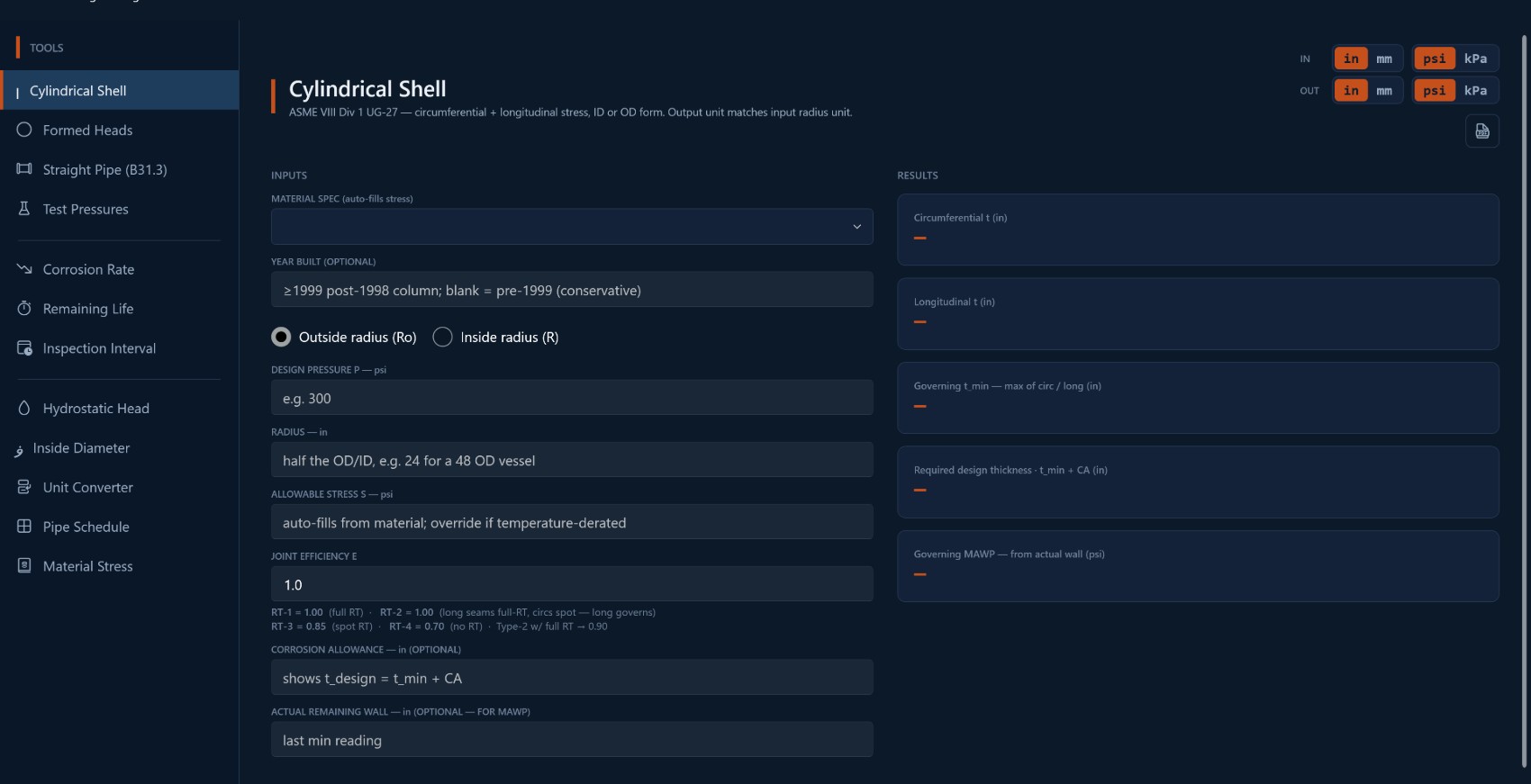
Shell and head calculators take the genuinely limiting case — t-min uses the larger of the circumferential and longitudinal requirements, and the rating MAWP takes the lower. Both ID-form and OD-form equations are implemented, because most data-plates give OD.

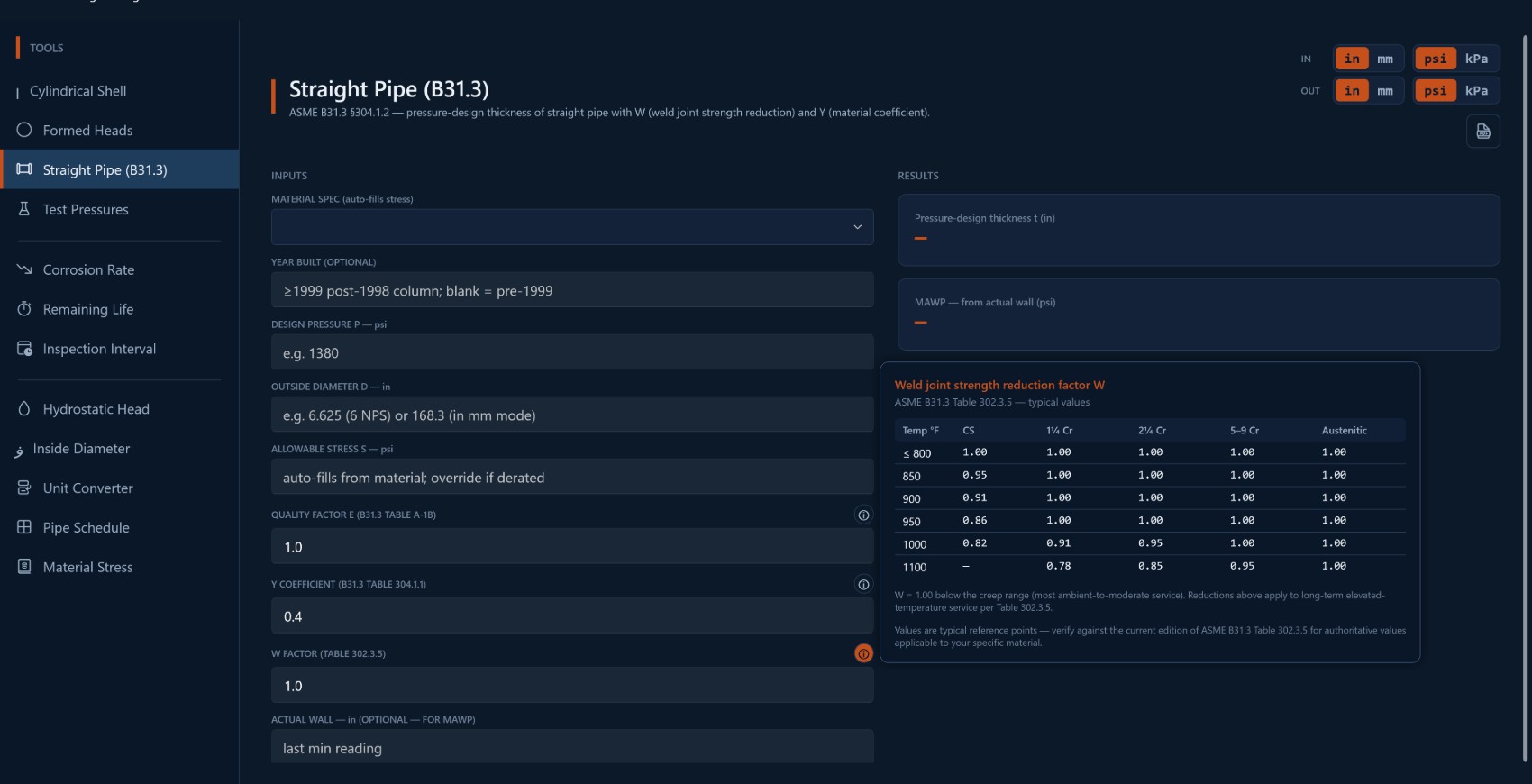
Straight Pipe carries the full B31.3 factor set, with pop-out ⓘ tables for the weld-quality factor E and the Y coefficient. Joint-efficiency fields even accept the RT stamp codes written on the data-plate.

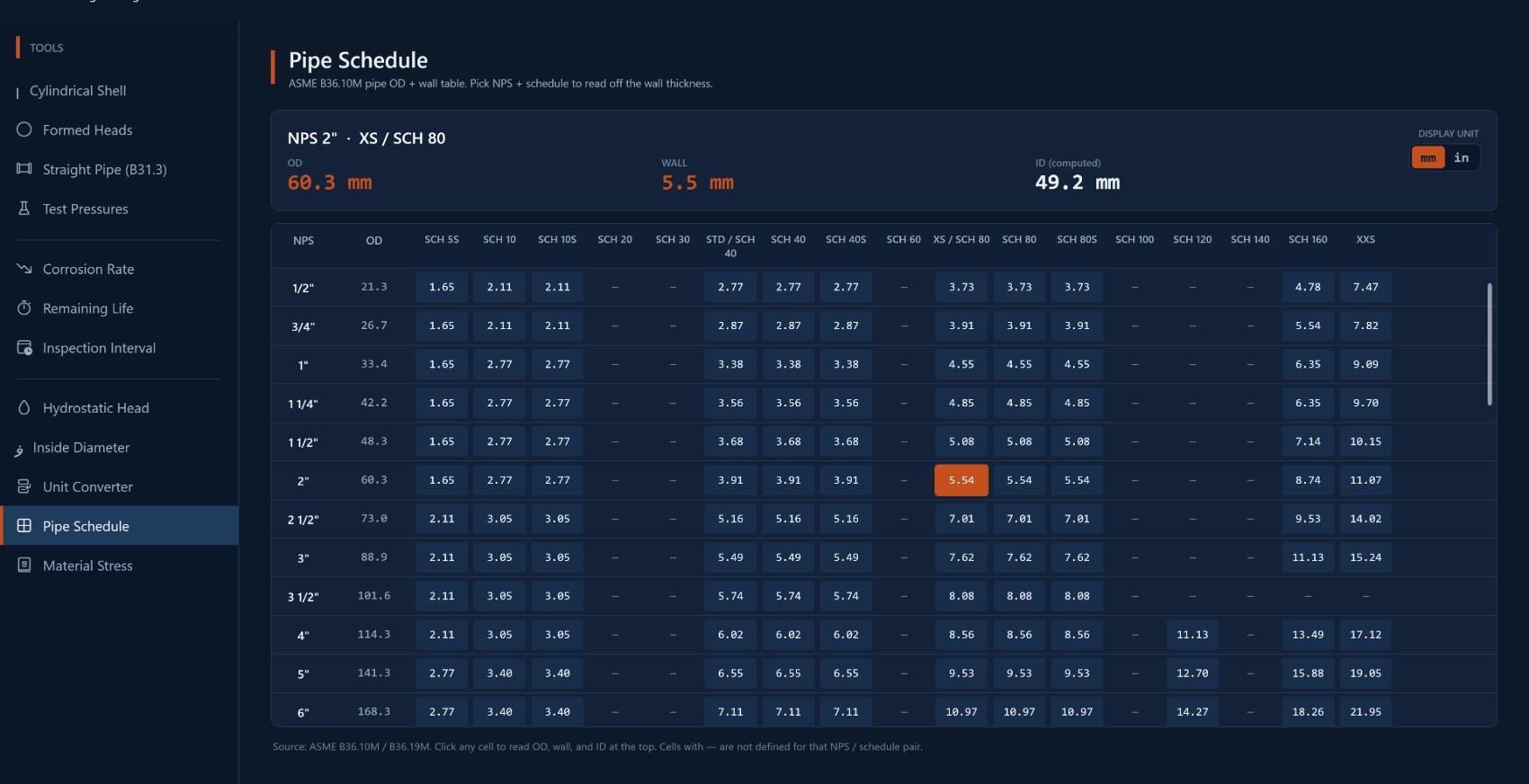
An interactive ASME B36.10M / B36.19M chart: pick a size and schedule to read off the wall thickness, click any cell for its OD, wall and computed ID, and toggle the whole table between millimetres and inches.

Across the whole suite
Several capabilities apply to every calculator — the things that make mixed-unit, real-world inspection math fast and safe.
Type a US vessel in inches and psi, read the answer in mm and kPa. Flip a toggle and typed values rescale in place — 0.5 in becomes 12.7 mm.
Enter a spec and build year; the allowable stress fills in from ASME II-D — keyed to the right era column, with manual override for derated service.
The E field accepts a decimal or the radiography stamp — RT-1 → 1.00, RT-3 → 0.85, RT-4 → 0.70 — and is forgiving of spacing.
There is no Calculate button — every result card updates on each keystroke as the inspector types.
Any result value or pipe-schedule cell copies straight to the clipboard for pasting into a report.
All math uses decimal rather than floating point, avoiding binary rounding drift in thickness and pressure figures.
Any design or inspection calculator exports a branded calculation sheet — the document an inspector attaches to a report as evidence of the math. It collects a vessel-information header, prints the inputs and results, and opens automatically when it’s saved.

Engineering integrity
A tested, unit-agnostic engineering core is the single source of truth for every formula — with attention to the subtle places a result can quietly turn wrong.
Remaining life runs down to the pressure-design t-min (per API 510 §2.2), not to t-min + CA — so a vessel isn’t retired the moment its corrosion allowance is spent.
ASME dropped the safety factor from 4.0 to 3.5 in 1999. Datum keys the allowable-stress column to build year, so an older vessel is never over-rated.
Every formula returns “no result” rather than a wrong one when inputs are missing or a denominator would go non-physical.
Inspection-program ceilings, built in. The interval calculator applies the half-life rule and caps it by the right code ceiling — API 510 internal 10 yr, external 5 yr; API 570 Class 1 piping 5 yr; injection points 3 yr.
See it on your numbers
We’ll run a live t-min, MAWP, corrosion-rate and remaining-life calculation on the call — and export the calculation sheet you’d attach to the report.
support@sifulogic.comDatum Engineer Calc implements standard ASME/API design equations as a calculation and documentation aid. Results must be reviewed and accepted by a qualified API authorised inspector and, where required, a registered professional engineer. It does not replace the governing code, the owner-user’s inspection program, or sound engineering judgement.